
Information
The running synchronous motor has a synchronous rotation to the AC voltage. This means that the rotor runs synchronously to the stator rotating field. The speed is therefore linked to the frequency of the AC voltage via the number of pole pairs. Due to its mass moment of inertia, this characteristic means that the motor cannot start up directly on the network without a starting aid (e.g. a starting cage, controlled via an inverter).
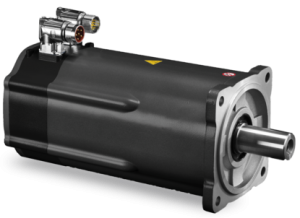
Typical synchronous motors are for example: Permanent magnet motors (left picture), Synchronous reluctance motors (see picture below), which are both available in IEC designs with the aim of achieving the greatest possible energy savings and small sizes, or in optimized designs in order to achieve the greatest possible power or torque in relation to the size in addition to the energy savings. These motors represent the state-of-the-art in drive technology.
For more information, please refer to the special pages on the individual motor technologies.
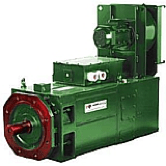
(picture left) Synchronous reluctance motor with forced cooling for demanding control tasks while maintaining very good efficiency (standard is IE4, Super Premium Efficiency).